
Finance
When Does a Startup Need a CFO? 7 Signs for Founders
Is a controller still enough, or is it time for a CFO? 7 signs that help founders recognize when an external CFO can truly move their startup forward. Includes a finance setup check.
01.10.2026
A startup needs a CFO as soon as financial issues start to pile up faster than the founders and the finance team can handle them. In practice, this usually happens before the first major funding round or once ARR (Annual Recurring Revenue) reaches around 1 million, often starting with a part-time fractional CFO. Does your controller provide accurate numbers, but were you caught off guard by the board’s latest question about the cash flow forecast? It’s one of several signs that indicate when a startup needs a Chief Financial Officer. There’s no set date, no exact revenue threshold—just a pattern of situations that keep recurring.
Most founders ask themselves this question too late—only when a funding round stalls or an investor questions a figure at a board meeting that no one can explain. Yet the need can be identified much earlier if you know what to look for.
This guide shows you 7 specific signs that indicate when an external CFO or in-house CFO services are more beneficial than just adding more Excel spreadsheets. And how you, as a founder, can make that decision before the pressure forces it upon you.
1. Investors ask questions that no one can answer
At a board meeting, a question comes up about unit economics, customer costs, or the next round of funding, and your team needs days to put together a solid answer. That’s exactly one of the clearest signs: investors expect well-informed answers in real time, not in a follow-up email three days later.
The pattern behind this is almost always the same: The numbers exist somewhere in the system, but no one had translated them into a story before the question was asked. A controller can confirm what happened. A CFO anticipates what will be asked and has the answer prepared before the meeting begins.
It's not just nerve-wracking. Every unanswered question in a board meeting sows a small seed of doubt about the team's ability to manage the company. That doubt lingers for a long time, especially when a funding round is coming up shortly afterward.
2. A funding round is coming up
Before a Series A or B round, investor reporting, a data room, and a robust financial projection are essential prerequisites. Without someone to tie this story together from a financial perspective, the process drags on. Every delay erodes bargaining power because it gives the other party the impression that the company lacks control.
According to the analysis “When to Hire a CFO: How to Know the Timing Is Right” (June 19, 2026, CRV, crv.com), three thresholds serve as useful guidelines: Starting at around $1 million to $3 million in ARR, a fractional CFO is usually a better option than a full-time hire. Starting at around $8 million in ARR, the volume of financial decisions typically exceeds what a founder or part-time employee can still effectively handle. This is also when many startups begin preparing for Series B funding. According to CRV, any company growing beyond $15 to $20 million in ARR without its own finance leadership is taking on more risk than the cost of a CFO in salary and equity. These figures are based on the U.S. market. In the DACH region, funding rounds and ARR levels are generally smaller, so the need often arises at lower revenue levels.
The reason it starts so early: A data room that’s cobbled together only in the weeks leading up to the term sheet looks exactly as it was put together. Investors can tell the difference between a finance department that has been keeping its records in order for months and one that was cleaned up at the last minute.
3. Cash flow and runway are unclear
If no one on the team can say off the top of their head how many months of runway are actually left, that’s not a reporting problem—it’s a management problem. Cash flow planning, burn rate, and scenarios are among the first tasks a CFO should organize, long before the situation becomes critical. The basic formula: Runway in months = available liquidity ÷ monthly net burn rate. For example, 1.2 million euros in the account and a net burn of 100,000 euros per month result in 12 months of runway.
The tricky thing about unclear cash flow is that it feels harmless for a long time. As long as there’s money in the account, everything seems fine. The moment the shortfall becomes apparent is usually also the moment when there’s hardly any room left to maneuver—whether to cut costs, secure bridge financing, or approach investors early on. A CFO can bring this moment of realization forward by months by making runway and scenario planning a fixed routine rather than an ad hoc exercise reserved for times of crisis.
4. Controlling Is Reaching Its Limits
A good controller provides reliable figures. What they usually don’t provide is the strategic context explaining why the figures look the way they do and what that implies. When reports arrive on time but without commentary or recommendations for action, it’s a lack of CFO-level insight—not just a lack of accounting.
This is not a criticism of the controller. The role is intentionally structured differently: accuracy, completeness, and transparency of the numbers. Strategic analysis, investor communication, and capital strategy are a different set of skills that rarely come together in a single person. Nor do they need to. The telltale sign is usually that founders themselves try to bridge the gap: they interpret the controlling figures on their own, without a finance background, and make strategic decisions based on them. To put it simply: The controller answers the question of how the last month went. The CFO answers what that means for the next 12 months. A fractional CFO brings this CFO-level expertise to the team on a part-time basis until a full-time position becomes financially viable. If processes and reporting are already faltering, the first step is to take a look at finance operations.
5. Multiple cost centers or business models emerge simultaneously
New product lines, a second market, or an additional pricing model can dramatically increase the complexity of financial management. What worked in an Excel spreadsheet with a single revenue source breaks down when there are three parallel business models—not because the spreadsheet was poorly designed, but because the problem has taken on a whole new dimension.
A typical example: A SaaS startup expands its core product to include a marketplace model or launches in a second country with its own pricing structure. Suddenly, individual segments require their own unit economics, their own cost allocation, and their own forecasts. Without structured financial management, it is no longer possible to accurately determine which segment is actually profitable.
6. M&A, an exit, or international expansion are on the horizon
As soon as an acquisition, an exit process, or entry into a new market becomes a reality, finance becomes a prerequisite rather than an afterthought. Accurate figures and a structured data room don’t materialize overnight. You need someone to prepare them in a timely manner—often months before the actual process begins.
In M&A and exit situations, there’s a particularly uncomfortable truth: Financial due diligence uncovers gaps that no one had noticed before because they were never reviewed as part of day-to-day operations. Anyone who discovers these gaps only during the review loses bargaining power—or, in the worst-case scenario, the entire deal. A CFO who is involved early on tests the numbers for robustness in advance.
7. You spend more time on finance than on your product
Perhaps the most telling sign: If, as a founder, you regularly spend your evenings working on forecasts, investor updates, or spreadsheets, you’re missing out on time for other things—the product, the team, and growth. A CFO doesn’t take away your responsibility, but they do take away the operational burden.
The common misconception here is: “I know my business best, so I’m best suited to handle the numbers myself.” While this is true when it comes to understanding the business model, it doesn’t apply to the technical aspects of building a sound forecasting model or structuring a compelling investor pitch. Time that a founder spends on the technical aspects of finance rather than on financial strategy is time spent in the wrong place.
Part-Time CFO or an In-House Finance Team: Which Is Right for Your Situation?
Not every sign immediately means you need a full-time CFO. The decision depends on the maturity of your finance setup and on how many signs are present at the same time:
Just one or two signals, early stage: A fractional CFO is usually enough—strategic guidance without the fixed costs of a full-time hire. This is typically the situation shortly after the seed round, when investors’ initial questions become more demanding but day-to-day operations are still manageable.
With multiple signals emerging simultaneously and a funding round on the horizon, CFO Services—with a clear focus on investor readiness and data room preparation—can establish a solid framework in just a few weeks. This situation calls for a more intensive engagement with a clear timeframe, typically spanning several months before and during the funding round.
A growing team, consistently high demand: Setting up your own finance department—including controlling, FP&A, and a dedicated CFO—makes good business sense. The point at which a full-time position becomes cost-effective is usually when the amount of time spent on external services is already close to that of a full-time position.
The rule of thumb: If demand is growing faster than a full-time position would be cost-effective, an external CFO is the obvious interim solution—not a stopgap measure. torq.partners covers all three stages: from fractional CFO and interim assignments to building an in-house finance team. Our consultants work out of Berlin and Munich and support startups throughout the DACH region, either on-site or remotely. Many startups remain in this model for years because it structurally fits their size, not because they “can’t yet afford” a full-time hire.
Frequently Asked Questions
At what point exactly does a startup need a CFO?
There’s no set date—rather, there are warning signs: unanswered questions from investors, an unclear runway, an upcoming funding round, or a controller who’s reaching their limits. As soon as two or three of these signs appear at the same time, it’s worth looking into CFO services.
Isn't a controller enough to start with?
Yes, a controller is often sufficient for day-to-day accounting and internal financial reporting. But when it comes to strategic analysis, investor communications, or preparing for fundraising, additional CFO expertise is needed.
How much does an external CFO cost for a startup?
It depends on the model. A fractional CFO is usually billed by the hour, while an interim CFO is billed at a daily rate for a temporary full-time role.
How quickly can a finance team be set up with CFO support?
Significantly faster than a traditional full-time hire—often within a few weeks—because there’s no need for a recruiting process and external CFO services can get started right away.
Does every startup really need a CFO at some point?
No. A startup that remains small and profitable—without external financing and without a complex structure—can often get by in the long run with just financial management and tax consulting. The points made in this article are particularly relevant for growth-funded startups with investors, multiple funding rounds, or increasing operational complexity.
What is the difference between a fractional CFO and an interim CFO?
A fractional CFO works part-time and provides strategic guidance over an extended period. An interim CFO takes on the full operational role for a limited time, such as after an employee leaves. Learn more in the comparison: External CFO vs. Interim CFO.
Conclusion: The 7 signals matter more than the calendar date
There’s no specific milestone at which a startup automatically becomes ready for a CFO. What matters are the warning signs: unanswered questions, numbers that no one trusts, and time you’re missing out on elsewhere. Those who recognize these signs early make decisions with confidence, not out of time pressure right before the next funding round.
Do you recognize several of these signs in your startup? Schedule a no-obligation consultation with torq.partners, and together we’ll determine whether an external CFO or setting up your own finance team is the next logical step.
Contents
Interim Support
Does your finance team need help?
Book a no-obligation initial consultation now.
Schedule a call
free download
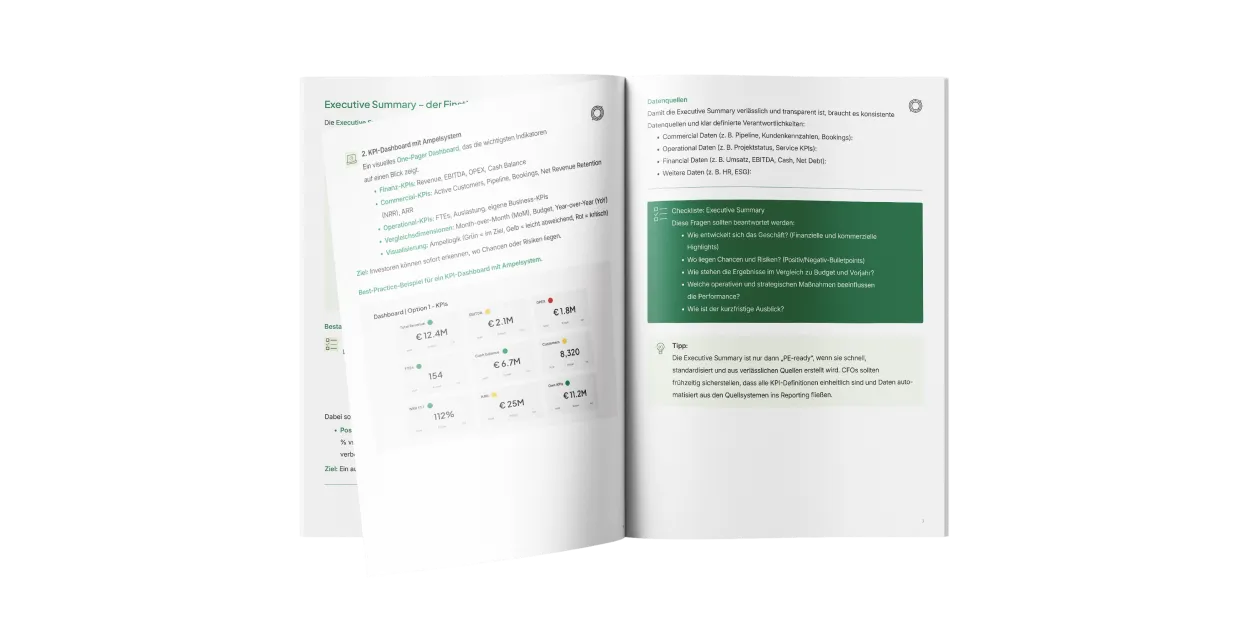
Investor Reporting at the Private Equity Level
Do's and Don'ts, Best-Practice Framework, and Checklist for Professional Investor Reporting at the PE Level. Free for CFOs and finance teams.
To Download →
podcast
How do I build a finance team? The 3-Zone Model.
Why most financial structures aren't put in place until it's already too late — and how things can be done differently.
Listen on Spotify →

More Articles

Finance
Fractional CFO: Responsibilities, Costs, and How to Choose the Right One for Your Startup
How much does a fractional CFO really cost, and when is this model a better option than an interim CFO or controller? The comparison guide for startups and scaleups, featuring cost estimates, selection criteria, and FAQs.
14.08.2026

Finance
External CFO vs. Interim CFO: Which CFO Solution Is Right for Which Growth Stage?
Series A funding round, delayed closings, sudden CFO resignation: Three situations, three solutions. The difference between an external CFO and an interim CFO lies not in their expertise, but in their mandate—strategic guidance or operational leadership.
17.07.2026