Employee Interview
Opportunities and Challenges on the Path to Becoming a Partner
Alina shares insights into her career path to becoming a partner and the corporate culture at torq.partners.
22.11.2024
Lena Hocker
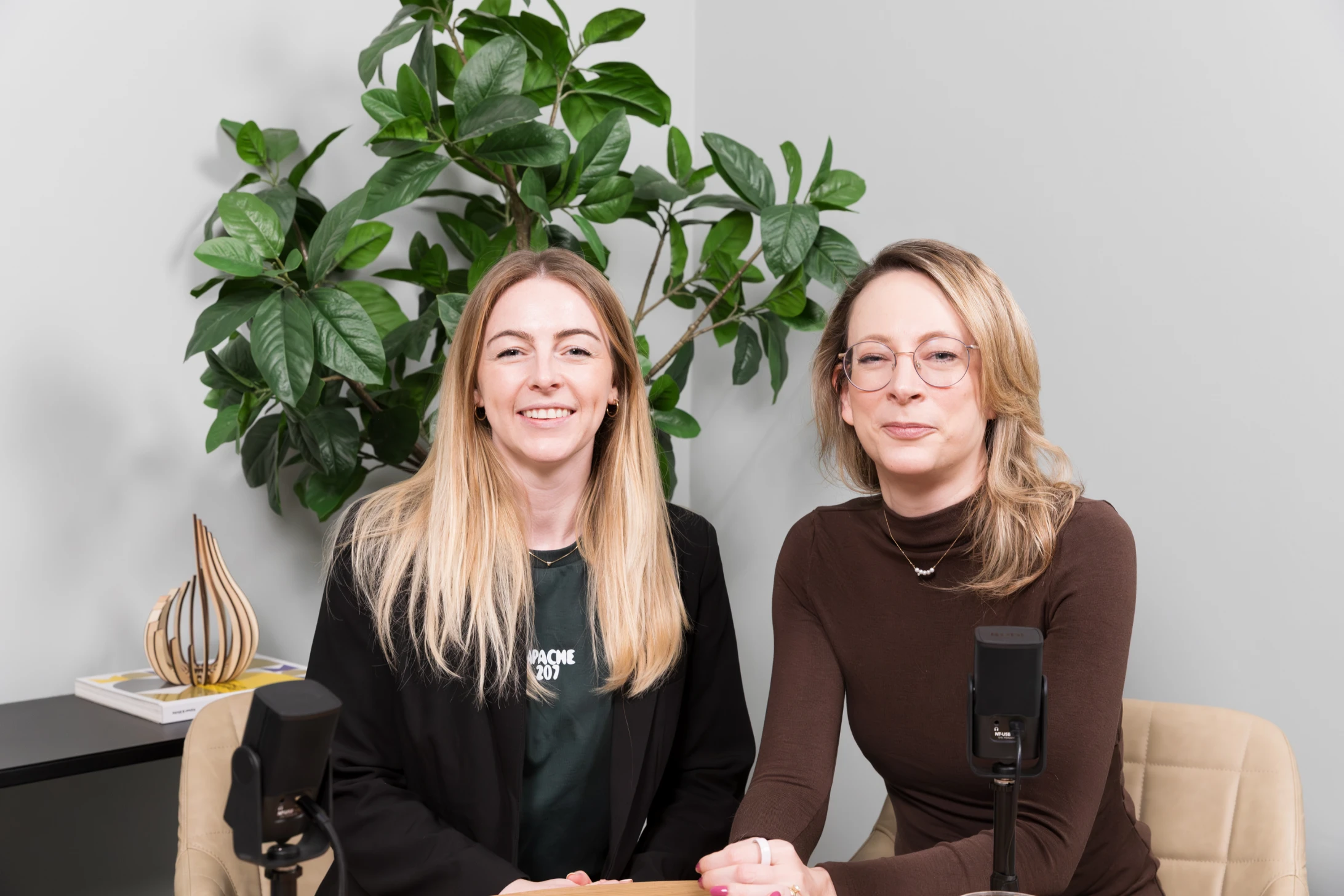
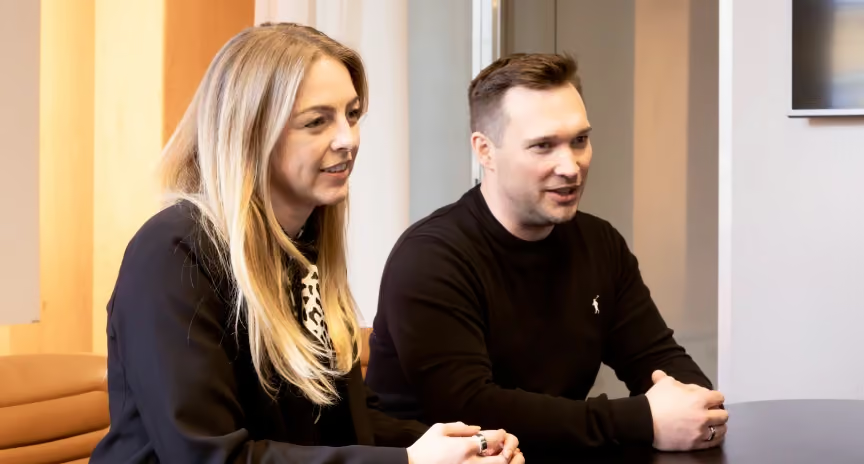
What does the career path to becoming a partner at torq.partners look like, and what makes working here special for employees? We discussed these and many other topics in our interview with Alina Nauen, who has been a Principal at torq.partners for about a year and a half and was the first employee at the company to take the significant step of becoming a partner. In our conversation, she shares insights into the opportunities and challenges of her role and explains her vision for healthy, values-driven company growth.
Alina, what has your career path been like, and what ultimately led you to torq.partners?
I started my career at a bank. After that, I spent many years in leadership roles in the finance departments of various startups and scale-ups in Berlin. In between, I also had the opportunity to gain experience in internal auditing. However, I always found myself returning to a CFO or Head of Finance role. After my last company was shut down following a decision by the investor, I looked for a position from which I could learn as much as possible. At torq.partners, I found exactly that: the prospect of getting to know many different companies through project work and being able to develop my skills quickly is what convinced me.
What do you like most about your work at torq.partners?
What I like best is the camaraderie and the supportive atmosphere among my colleagues. Because we work in a large team, whenever challenges arise, there’s always someone who has already faced a similar problem and can offer support based on their experience. We also foster an open culture of feedback, where it’s okay to speak up if something didn’t go as well as it could have. The dialogue is always respectful. I also appreciate the variety in my work. I lead a team of talented consultants, all of whom are working on different projects with varying challenges, while at the same time serving as an interim CFO for my clients.
How has your personal career at torq.partners progressed?
At first, I spent half a year working exclusively on projects and took on a leadership role there. It was a very intense period, as I had to take over a large number of clients due to some staff departures. But I was then quickly given responsibility for a more comprehensive project, which took up most of my time. However, the way we do project work here is that you’re usually not scheduled for a full 40 hours. This gives you the opportunity to tackle other tasks on the side. That’s how I ended up taking over a team of four at the beginning of the year. I also recently became a partner at torq.partners.
How did torq.partners support you in this development?
On my path to becoming a team lead, I was supported by the leadership program. As team leads, we have regular meetings with the HR department to discuss pressing issues within the team. We also participated in leadership training sessions where we examined challenging situations and gained theoretical knowledge about torq.partners’ leadership approach. To support the development of new partners, the Partner Development Program was launched this year, with a handful of Principals participating. It consisted of three pillars: First, there was a partner shadowing session, during which we each spent a day shadowing every partner individually. This gave us an understanding of what it means to be a partner and how differently that role can be shaped. The second pillar was “Business Therapy,” in which we had group coaching sessions focused on approachability, empathy, and communication, which helped us get to know ourselves and our own public image better. In my opinion, that was an absolute highlight. The third pillar was “Skill Development,” during which we learned various hard skills. The program lasted about nine months in total and really brought us closer together as a group.
What were the biggest challenges you faced on your journey to becoming a partner?
I had my ongoing projects, my internal team, and, on top of that, a development program event every two to three weeks that took up a whole day each time. I would view this double workload as a challenge, but not exclusively in a negative sense. Sometimes it’s important to broaden your horizons and take on a heavier workload in order to gain new experiences. You’ve now successfully completed the Partner Development Program. Are there other areas where you’d like to continue your professional development? There are so many! One area that interests me is organizational development, particularly in the area of coaching. I can definitely see myself helping companies build effective team structures and optimize collaboration within groups. I believe there’s enormous potential there. I’d also be interested in taking on a supervisory board position, though more in the medium to long term.
What is your vision for torq.partners in the coming years?
I hope for healthy growth for torq.partners, as I still see a lot of potential in the market. In doing so, it’s important to me that we live by our values—courage, dedication, respect, and responsibility—continue to develop them, and instill them in every new employee. That way, we can shape our path together. I want to actively contribute to ensuring that our growth always aligns with our values. Work plays such an important role in our lives that I believe everyone should be able to be the best version of themselves at work as well. For me, this includes leading a healthy lifestyle and being able to manage stressful periods. I think it’s important that each of us can put this into practice in our daily lives, and I’m committed to making that happen. After all, satisfied employees are the key to healthy growth.
The fact that you are the first woman to be named a partner at torq.partners is a major milestone in the company’s history. What does this step mean to you?
I’m absolutely thrilled about this. For me personally, this is a major and significant step. It was wonderful to experience how warmly and sincerely all the women congratulated me. Their joy at my success was truly palpable. Being the first woman in the group also has an impact on the outside world that shouldn’t be underestimated. My vision is to use this to inspire and encourage other women to empower themselves. In keeping with the theme of women’s empowerment, you also recently hosted a dinner for the female employees at torq.partners. What was that all about? Over the past year, torq.partners has undergone a major transformation in terms of its corporate values. Among other things, this has led to the creation of an initiative that addresses socially important issues that lie outside the scope of our day-to-day consulting work. As part of this, I founded a women’s working group at torq.partners, which currently consists of five members. Our goal is to support women within the company and give them the motivation to become more self-confident and stand up for themselves.
To that end, we launched a dinner series. For the first event, we focused on the topic “How Do Women Invest?” and gathered and shared information on various asset classes in the run-up to the event. I was impressed by how positively it was received. The event provided an authentic space where participants could speak openly about their perspectives on investing. I think everyone took away some valuable insights from the dinner on how they can reposition themselves in this area to become and remain financially independent.
In your view, as a female executive, what can companies do to better support women's career development?
Equality should always be a priority in all business processes. In recruiting, it’s important to structure the candidate pool so that men and women are equally represented. This can be achieved through targeted employer branding and outreach across various channels. I think this is the foundation for achieving equality. In addition, measures to support women should be implemented in day-to-day business operations, such as through leadership and negotiation training. It remains a problem that women do their work quietly. They achieve great results but may not speak up about them. Creating a platform that makes it possible to highlight strong performance is a powerful tool for achieving equality.
To wrap up our conversation, do you have any advice you’d like to share with other women in the finance industry?
My tip builds on the advice I give to companies to further empower women. Make your work visible! If there are channels where you can share your successes, you should do so. Talk about the great work you’re doing. That way, you can position yourself and use the results you’ve achieved to your advantage.
Contents
Interim Support
Does your finance team need help?
Book a no-obligation initial consultation now.
Schedule a call
free download
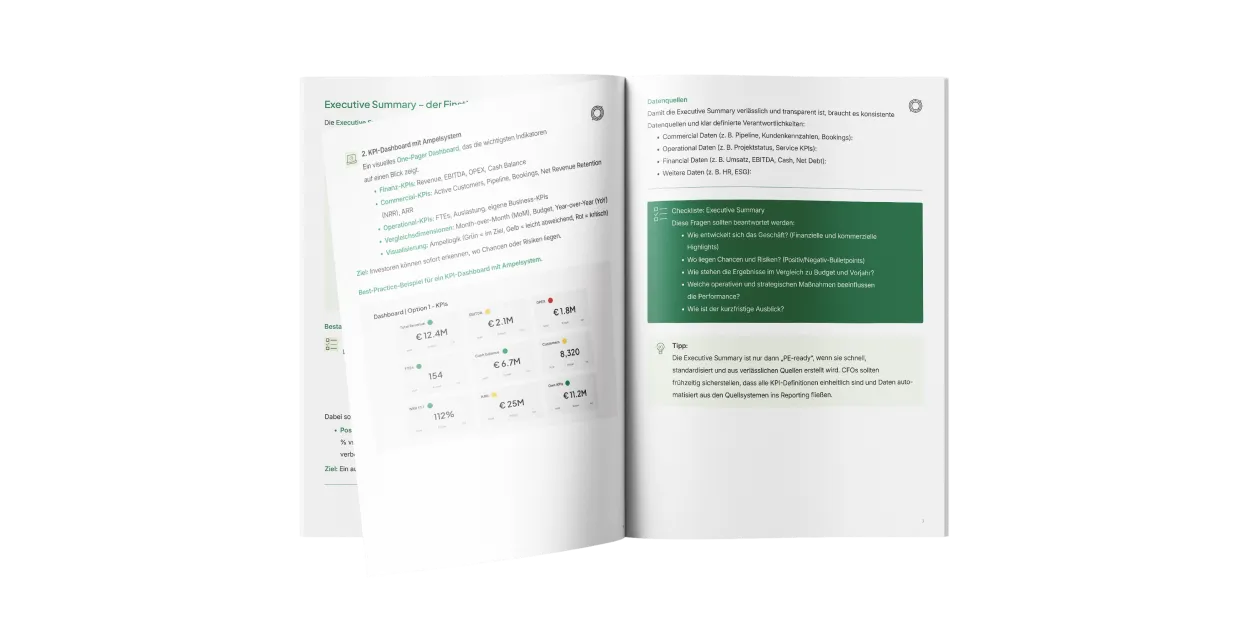
Investor Reporting at the Private Equity Level
Do's and Don'ts, Best-Practice Framework, and Checklist for Professional Investor Reporting at the PE Level. Free for CFOs and finance teams.
To Download →
podcast
Finance Careers, Networking, and Visibility with Aylin Schaer
Careers in finance, self-employment, networking, and visibility in the Female Finance Circle.
Listen on Spotify →