
Investor Readiness
How Does Financial Due Diligence Work? A Step-by-Step Guide to the Process
Red Flag or Full Scope? Drawing on over 100 financial due diligence (FDD) reviews since 2022, we show what’s actually examined in a financial due diligence process and how it works. The guide for founders and investors before their next deal.
10.08.2026
Florian Blaschke
A term sheet is on the table, the closing is scheduled for eight weeks from now, and now it’s time for financial due diligence. Financial due diligence (FDD) is the process of reviewing a company’s financial health prior to an investment or acquisition. It answers one question: Are the numbers underlying the deal accurate?
Anyone going through a financial due diligence process for the first time usually underestimates what’s involved and how much the outcome depends on thorough preparation. This guide walks you through the financial due diligence process step by step, based on over 100 financial due diligence projects we’ve supported since 2022.
Key Points at a Glance
Financial due diligence is conducted prior to an investment or acquisition to verify whether a company’s financials are sound. The process consists of five phases and typically takes two to three weeks. Depending on the deal, the scope ranges from a quick “red flag” FDD to a comprehensive “full scope” FDD. The costs depend on the number of companies to be reviewed and the complexity of the business model.
What Is Financial Due Diligence, and When Do You Need It?
Financial due diligence verifies whether a company’s reported figures are reliable before any money changes hands. The client is almost always the buyer or investor—that is, a venture capital fund, a family office, or a strategic acquirer. Unlike an audit of annual financial statements, it does not issue an audit opinion. Instead, it tests the assumptions on which the valuation is based.
The need arises in a few specific situations:
- Before a funding round, when a lead investor wants to verify the startup's financials
- Before an acquisition (M&A), in which the buyer must secure the purchase price and mitigate risks (for more on this, see the article “The M&A Process for Startups”)
- When planning to raise debt capital, if a lender assesses the borrower's ability to repay
- Vendor due diligence, when the seller initiates the process themselves to expedite the sale
The FDD typically comes into a company's life just as it is scaling up from its early stages and preparing for its first major funding round.
For Which Companies We Conduct Financial Due Diligence
We audit startups and scaleups in their growth phase, not large corporations. Our clients are primarily venture capital funds, family offices, and strategic investors who want to understand a target company before making an investment. This is precisely where we differ from the major audit firms: We specialize in the phase where financial data is still emerging and processes are still being established.
The profile of the companies audited from over 100 FDDs:
- Business model: roughly half B2B SaaS and software, plus services and operations, hardware and manufacturing, SaaS plus hardware, and platforms and marketplaces
- Stage of development: on average, about five years old, usually between the first round of Series funding and the scale-up phase
- Size: Annual revenue is primarily in the low single-digit millions or below; teams typically consist of between 10 and 50 employees
- Sectors: broadly diversified across HR tech, fintech, health tech, and medtech; proptech; edtech; agtech; cleantech; and industrial software
- Region: Focus on Germany, Austria, and Switzerland (DACH), supplemented by neighboring European countries
If your company is in this phase, we’re already familiar with the typical patterns of your business model. This makes the audit faster and the findings more precise.
Financial Due Diligence vs. Other Types of Due Diligence
Financial due diligence is only one part of the overall due diligence process. It examines the financial figures, while other types of due diligence examine other aspects of the deal. Here’s how to categorize the due diligence review:
- Financial Due Diligence: Profitability, Revenue Quality, Working Capital, and Cash. The question: Do the numbers add up?
- Commercial Due Diligence: Market, Competition, and Viability of the Business Model. The question: Can the market support this growth?
- Legal Due Diligence: Contracts, Corporate Structure, and Legal Risks. The Question: Are There Any Legal Obstacles?
- Tax Due Diligence: Tax Risks and Structures. The Question: Are There Hidden Tax Liabilities?
- Tech Due Diligence: Technology, codebase, and scalability—especially in tech deals. The question: Can the technology keep up with growth?
A common misconception: Financial due diligence (FDD) is not an audit. An audit of financial statements verifies past performance according to established standards and results in an audit opinion. Financial due diligence focuses on assumptions relevant to the transaction and does not require an audit opinion. The two processes complement each other but are not interchangeable.
Red Flag, Full Scope, or Confirmatory: Which FDD Is Right for Your Deal?
Not every financial due diligence process has the same scope. The appropriate level of detail depends on the deal size, time frame, and risk appetite. In practice, we encounter four formats:
Red Flag FDD: The Quick Check. We review the numbers for critical warning signs and provide an executive summary with a list of flags (real risks) and remarks (points to follow up on). It’s not a complete financial model, but it’s done in days instead of weeks. It’s useful early in the process, when you just want to know if the deal is even worth pursuing.
Full Scope FDD: The comprehensive review. It includes a detailed financial analysis (income statement, cash flow statement, balance sheet), an assessment of the quality of earnings, and a description of financial processes. This is the standard format for investments involving a substantial amount. About half of our reports fall into this category.
Confirmatory FDD: The confirmatory due diligence. It specifically verifies individual assumptions when the deal is already well underway and only residual uncertainties remain.
Hybrid Format (QoE / Revenue Sanity Check): A focused snapshot, such as a review of revenue or ARR alone, without the full process descriptions. This is appropriate when the client wants to clarify exactly one specific question.
Quick Reference for Selecting the Format:
- Initial Assessment Before the Term Sheet → Red Flag FDD
- Time to make an investment or purchase decision → Full Scope FDD
- Deal almost signed, final doubts → Confirmatory FDD
- Focus on just one key metric (e.g., ARR) → QoE / Revenue Sanity Check
How Financial Due Diligence Works at torq.partners
The process follows the same basic pattern in every format, regardless of the level of detail. From the initial engagement to the final report, the due diligence process goes through five phases.
Phase 1: Scoping and Defining the Scope of Work. We work with the client to determine the key questions raised by the deal, the appropriate format, and the time period to be reviewed. The result is a clearly defined scope, ensuring that we focus our review on the right areas.
Phase 2: Data Request. We compile an Information Request List and assist with setting up the data room. The more complete the documents are when they arrive here, the faster the rest of the process will proceed. This is often the point that determines the pace of the entire process.
Phase 3: Analysis. We go through the numbers: revenue quality, cost structure, working capital, and cash runway. At the same time, we examine how these figures are derived—that is, the core finance processes (order-to-cash, purchase-to-pay, and record-to-report)—as well as the team and the tools they use.
Phase 4: Management Q&A. We clarify any outstanding issues directly with the target company’s finance team. Some of the findings are resolved at this stage, while others crystallize into genuine red flags.
Phase 5: Report and Debrief. We deliver the report, which includes an executive summary, findings, and analysis. During the debrief, we work with the client to discuss what the results mean for the valuation and deal structure.
What Is Actually Tested in the FDD
Financial due diligence focuses on the soundness of key financial metrics rather than on individual journal entries. These areas are central to nearly every financial due diligence process:
- Quality of Earnings (QoE): How sustainable are the reported earnings? We adjust for one-time effects and extraordinary items to highlight recurring profitability.
- Revenue and ARR Quality: For SaaS businesses, we verify whether the reported Annual Recurring Revenue (ARR—revenue extrapolated to a full year) is truly recurring. Cohorts, net revenue retention, and contract terms reveal whether growth is genuine or inflated.
- Net Working Capital: How much capital is tied up in operations? Working capital often has a direct impact on the purchase price.
- Cash and Runway: How Long Will Liquidity Last? For young companies in particular, cash runway determines how much room they have to negotiate.
- Financial Model and Planning: Do the forecast assumptions hold up to critical scrutiny, or are they just wishful thinking?
For hardware and manufacturing companies, the focus shifts to margins, inventory, and capital requirements. The framework remains the same; we adapt the priorities to the business model.
Why We Also Look at Financial Processes
Numbers are only as reliable as the processes that generate them. That is why a comprehensive FDD also examines the path to those numbers—that is, the processes behind them. The focus is on three process chains:
- Order-to-Cash (O2C): From order placement to receipt of payment. This metric shows how accurately revenue is recorded and how quickly cash flows into the company.
- Purchase-to-Pay (P2P): From procurement to payment to suppliers. This process says a lot about cost control and accounts payable.
- Record-to-Report (R2R): From posting to the final financial statements. How long does the monthly closing take, and how robust is the process?
A company can report strong financial results and still have flawed processes. This also applies to startups that outsource their accounting: Even external processes must be documented in a way that stands up to due diligence. For an investor, this distinction is crucial because, once the deal is closed, they will inherit precisely these processes.
How long an FDD takes and how much it costs
At torq.partners, a financial due diligence typically takes two to three weeks. The exact duration depends on the chosen format and the quality of the data provided. A Red Flag FDD can be completed more quickly, while a Full Scope FDD tends to take up the entire timeframe. The biggest time-consuming factor is rarely the analysis itself, but rather waiting for documents.
How much does financial due diligence cost? That depends on two factors: the number of companies to be reviewed and the complexity of the business model. A single SaaS company with well-organized accounting is at the lower end of the spectrum, while a group with multiple entities, foreign subsidiaries, or hardware components is at the upper end. A fixed price would be unrealistic; establishing a clear framework during the scoping discussion is standard practice.
If you're on the target company's side, being well-prepared will significantly speed up the process. Here are some things you should have ready before you begin:
- Monthly financial figures for the past two to three years, consistent and transparent
- A reconciliation of revenue from the raw data to the reported figure
- For SaaS: an ARR bridge and cohort data
- A current working capital and cash statement
- Access to your accounting and reporting tool
Does that seem like a lot to you? This is exactly where good FDD preparation comes in. If you clean up the data room beforehand, you can prevent simple inquiries from turning into “Findings” in the report. We also discuss how to make your startup fundamentally M&A- and DD-ready in our podcast episode on M&A and due diligence readiness.
The Most Common Findings from Over 100 FDDs
Over the years, certain patterns have emerged, regardless of industry or company size. Based on more than 100 financial due diligence reviews conducted since 2022, we see the same issues recurring time and again:
- Revenue Recognition: Revenue is recognized too early or inconsistently, which distorts the apparent growth.
- ARR Quality: The reported ARR includes one-time setup fees or contracts that were terminated long ago.
- Working Capital: The capital requirements for the operating business are higher than presented in the pitch.
- Cash Runway: Cash reserves are running out sooner than planned, which shifts the balance of power in negotiations.
- Processes and Data Quality: The monthly closing is taking a long time, and figures from different sources contradict each other.
Two anonymized examples from our practice illustrate how this works in practice. In an audit of a B2B SaaS company prior to its Series A round, the reported ARR included one-time setup fees. After adjusting for these fees, the truly recurring revenue was noticeably lower, which altered the basis for valuation. In a hardware business, inventory tied up significantly more capital than the pitch had suggested, which shifted the investor’s runway calculations.
None of these issues has to be a dealbreaker. What matters is that both sides are aware of them early on. A clearly documented finding is negotiable, but a surprise discovered late in the process is rare.
Frequently Asked Questions About Financial Due Diligence
Who prepares startups for financial due diligence? torq.partners prepares startups and scaleups for financial due diligence by setting up the data room and anticipating typical findings. We draw on that same experience when conducting the review on behalf of investors.
How much does financial due diligence cost? The cost depends on the number of companies to be reviewed and the complexity of the business model. Individual companies with well-organized accounting are less expensive than groups with multiple entities or foreign subsidiaries. We determine the specific scope during the scoping meeting.
How long does a financial due diligence take? Usually two to three weeks. A red flag FDD is completed more quickly, while a full-scope FDD takes longer. The pace depends primarily on how complete the data is.
What is the difference between a Red Flag FDD and a Full Scope FDD? A Red Flag FDD is a quick check for critical warning signs, including an executive summary and a list of red flags. A Full Scope FDD is a comprehensive review that includes financial analysis, quality of earnings, and a description of processes.
Which financial partners have experience with due diligence and deal structures? Since 2022, torq.partners has supported over 100 financial due diligence projects for VC funds, family offices, and strategic investors in the DACH region, with a focus on B2B SaaS and high-growth startups.
What does a financial due diligence review examine? A financial due diligence review examines the quality of earnings, revenue and ARR quality, net working capital, cash runway, and the robustness of financial planning, as well as the processes behind the numbers (O2C, P2P, R2R).
Conclusion
Financial due diligence is the reality check that takes place before a deal. The process follows a clear pattern: define the scope, collect data, review figures and processes, clarify outstanding issues, and deliver a report. The depth of the review depends on the format, ranging from a quick “red flag” FDD to a comprehensive “full scope” FDD.
Whether you need a thorough due diligence review for investors or want to prepare your startup for the next funding round: We’ve supported over 100 FDDs and know what matters most. You can find more information about our financial due diligence services for investors on our services page. Schedule a no-obligation consultation with us and let’s figure out which FDD format is right for your deal.
Contents
Interim Support
Does your finance team need help?
Book a no-obligation initial consultation now.
Schedule a call
free download
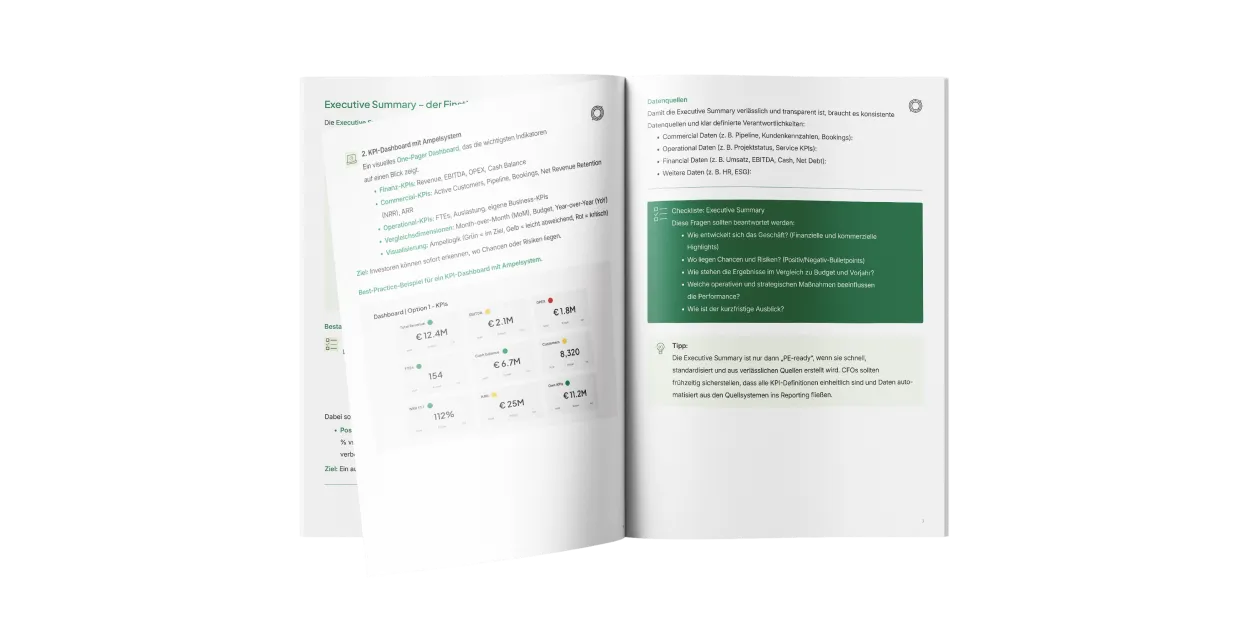
Investor Reporting at the Private Equity Level
Do's and Don'ts, Best-Practice Framework, and Checklist for Professional Investor Reporting at the PE Level. Free for CFOs and finance teams.
To Download →
podcast
Exit Story: DD Readiness for SaaS Companies with Marco Feelisch of Pathway
Exit readiness, due diligence preparation, strategic partner selection, and cash discipline in SaaS.
Listen on Spotify →

More Articles

Finance
External CFO vs. Interim CFO: Which CFO Solution Is Right for Which Growth Stage?
Series A funding round, delayed closings, sudden CFO resignation: Three situations, three solutions. The difference between an external CFO and an interim CFO lies not in their expertise, but in their mandate—strategic guidance or operational leadership.
17.07.2026

Accounting & Controlling
How to Prepare Your Annual Financial Statements – Here's the Right Way to Do It
At the end of the fiscal year, most companies must prepare their annual financial statements. Extensive preparations are necessary to ensure this is done correctly. Our checklist provides you with a good guide for this.
14.02.2024